
How I Fixed the Dropping CTR Issue for a B2B SaaS Brand

Industry
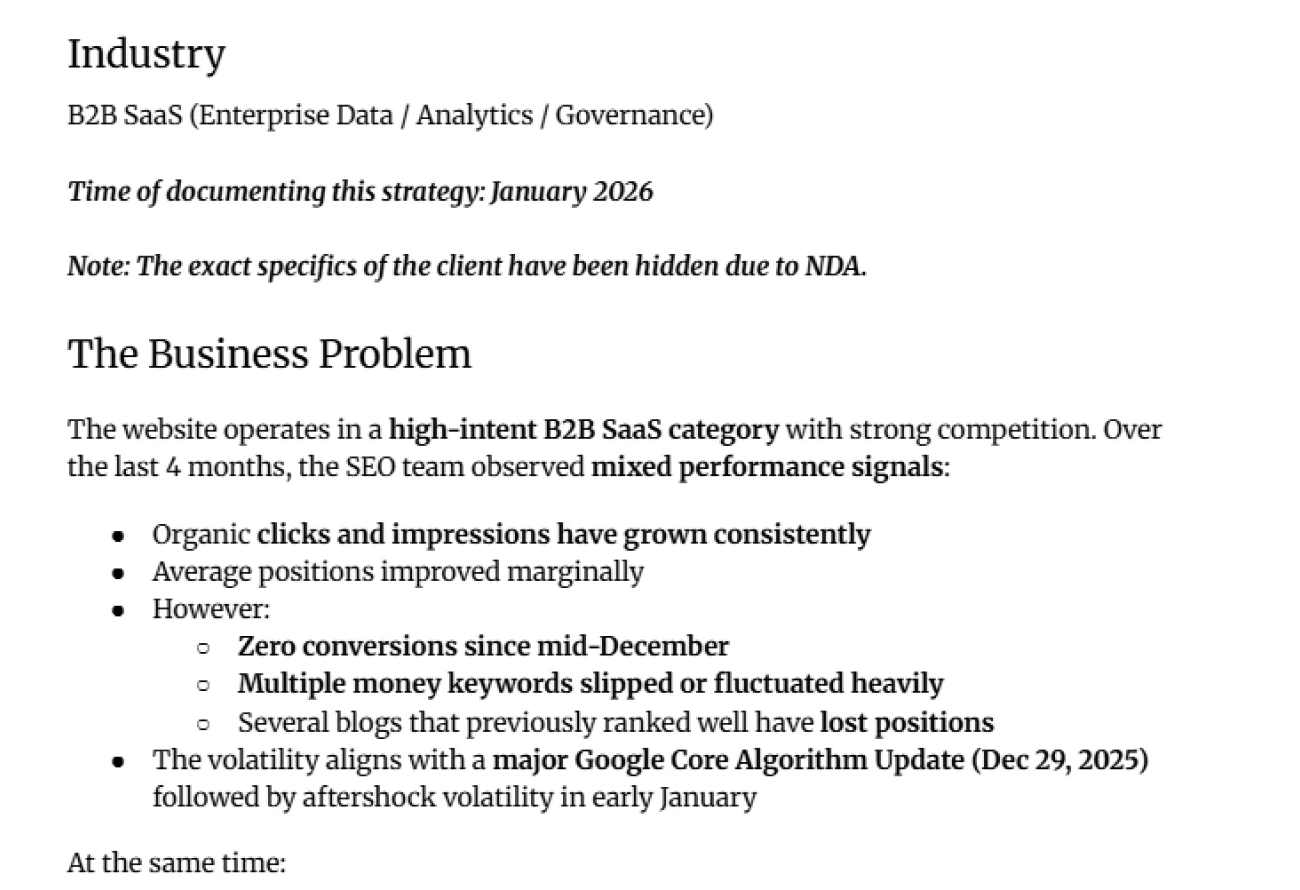
B2B SaaS (Enterprise Data / Analytics / Governance)
Time of documenting this strategy: January 2026
Note: The exact specifics of the client have been hidden due to NDA.
The Business Problem
The website operates in a high-intent B2B SaaS category with strong competition. Over the last 4 months, the SEO team observed mixed performance signals:
- Organic clicks and impressions have grown consistently
- Average positions improved marginally
- However:
- Zero conversions since mid-December
- Multiple money keywords slipped or fluctuated heavily
- Several blogs that previously ranked well have lost positions
- The volatility aligns with a major Google Core Algorithm Update (Dec 29, 2025) followed by aftershock volatility in early January
At the same time:
- Competitors in the same category are experiencing similar turbulence
- The website has growing AI / LLM visibility, but this hasn’t translated into pipeline impact yet.
Data I Had to Work With
Key signals:
- Post-core update ranking instability (keywords oscillating between positions ~30–38)
- 26 blog posts lost rankings after initially performing well
- 68 previously optimized blogs showing declining clicks
- Strong growth in impressions, but CTR stuck at ~0.1%
- Increasing visibility in AI-powered discovery (LLMs), but unclear SEO leverage
Expectations from Me
As a Senior SEO Executive, I was expected to help stabilize, recover, and scale organic performance.
Part I: Diagnosis – Speaking to the Brand
Given the Enterprise B2B SaaS client scenario, here is what I understand:
The “growing impressions but zero conversions” suggests that your SEO effort is winning on broad awareness but losing on decision-maker trust.
Here is the root-cause analysis for specific pointers:
1. Ranking Volatility (Keywords oscillating 30–38)
- “Middle-of-the-Pack” Re-evaluation: Positions 30–38 indicate Google recognizes your relevance but lacks “confidence” signals. The update likely shifted the weight of Topical Authority, meaning your website’s authority indications got weakened due to a slight loss of context. And since you have mentioned that the competitors are facing similar turbulence (which is a good thing per me), they might have been asking the same questions as you are.
- SERP Feature Displacement: In Data/Analytics, Google is increasingly swapping traditional links for “Product Grids” or “Feature Comparisons.” Your keywords are oscillating because the SERP layout itself is unstable as Google tests which B2B intent (educational vs. tool-selection) wins.
- The “Freshness” Decay: The AI/LLM space updates multiple times daily, so content from 6 months ago is “grossly outdated.” The update likely applied a stricter decay filter to data governance topics, causing static pages to bounce as Google looks for updated regulatory/LLM-integration context. Meaning, you are using information that is several months old, and Google thinks that you should have updated the content by now, which you didn’t, hence the partial penalty.
2. Loss of Conversions (Zero since mid-Dec)
- Intent Mismatch: Your 0.1% CTR and high impressions suggest you are ranking for high-volume, low-intent terms (e.g., “what is data governance”). You’ve won the “Information” battle but lost the “Commercial” one. Decision-makers are bypassing your top-of-funnel content.
- E-E-A-T Friction in YMYL: Enterprise data is high-stakes. If your “Money Pages” (Demo/Pricing) don’t feature social proof, SOC2/ISO certifications, or case studies prominently, the Dec 29 update, which doubled down on Trustworthiness, may be suppressing your “conversion-ready” snippets in favor of more established giants.
- The “AI Overload” Leak: Your AI/LLM visibility is likely answering the prospect’s technical questions within the AI Overview. If your content is “definitional” rather than “operational,” the user gets the answer from the LLM and never clicks the “Book a Demo” button. You need to clearly define the writing style and aim of your long-form and AI overview content/topics.
3. Underperformance of “Optimized” Blog posts
- Information Gain Deficit: Most “optimized” SaaS blogs are essentially rewrites of the top 5 competitors (I mentioned this during yesterday’s interview as well.) The Dec 29 update penalizes “SEO-first” content that offers zero unique data or proprietary insights. Without original enterprise use cases, your blogs are viewed as redundant.
- Snippet Canonicalization: Google may be using your blog’s content to feed an AI Overview but ranking the competitor’s site below it. You are providing the “fuel” for the LLM result, but not getting the “reward” of the click. Google is smart here – it is satisfying the user’s query but making the competitors fight among themselves even more fiercely.
- Over-Engineering for Robots: Honestly, blogs optimized specifically for “keywords” rather than “Job-to-be-Done” (JTBD) are failing. If your blogs follow a rigid H1-H2-H3 SEO template but don’t address the specific pain points of a Data Officer, Google’s User Satisfaction signals (pogo-sticking) are dragging you down.
Clear Differentiation
To address the stagnation in an Enterprise B2B SaaS environment, especially where impressions are high but CTR and conversions are floor-level, we must look at the “Value Gap” created by the December 2025 update.
You need to understand that in this niche, Google has shifted from rewarding “Relevant Information” to rewarding “Authoritative Resolution.”
1. Algorithm-Related Factors
Why Google is treating your pages differently.
- The “Information Gain” Threshold: The Dec 29 update integrated a stricter “Information Gain” score, as per my research. Pages that survived provided proprietary data, unique frameworks (e.g., a “Data Governance Maturity Model”), or internal screenshots. Pages that failed were “SEO-Synthesized”, meaning they covered the same points as competitors but offered no new data for Google’s LLM to learn from.
- Knowledge Graph Disconnection: For Enterprise SaaS, Google evaluates the relationship between your “Money Keywords” and your “Brand Entities.” If your brand isn’t strongly associated with “Enterprise Security” or “Governance” in the Knowledge Vault, your rankings will oscillate (30–38) as Google treats you as a “generalist” rather than a “specialist.”
- AI Overview (SGE) cannibalization: High impressions with low CTR (0.1%) suggest your “optimized” blogs are being used as training data. Google extracts the answer for the AI Overview, satisfying the user’s intent on the SERP. Survivable pages are those that offer “Complex Toolkits” or “Interactive Calculators” that an AI cannot summarize in a text box. Since your competitors are facing similar issues, it’s an opportunity for you to beat them with the solutions I have mentioned below.
2. Content-Related Factors
Why your blog posts lost positions despite being “optimized.”
- You need to understand the context bridge here: The 68 declining blogs likely lack “Lived Experience” (the extra E in E-E-A-T). In B2B, Google now detects “thin” professional advice. If a blog about Data Lineage reads like it was written by a copywriter instead of a Data Engineer, it loses the “Helpfulness” signal. Survivable content usually includes expert quotes, code snippets, or real-world implementation hurdles.
- Intent Decay (Educational vs. Commercial): Many SaaS blogs are optimized for “What is…” terms. Post-update, Google realized that for “Enterprise Data,” users searching “What is…” are often students or researchers (low conversion), while buyers search for “Integration challenges” or “Vendor comparisons.” Your blogs are stuck in the low-intent bucket. Again, there is an issue with the content intent.
3. Structural / SEO Execution Gaps
The technical “pipes” are causing the leak.
- Conversion Friction & “YMYL” Signals: Since mid-Dec, Google has placed higher scrutiny on the “Trust” signals of the conversion path. If your demo pages lack SOC2 badges, clear Privacy Policies, or verifiable customer logos near the CTA, the “Trust” score of the entire directory drops, leading to zero conversions.
- Internal Link “Dilution”: Your 68 underperforming blogs may be “orphaned” or linked in a flat structure. High-performing sites use a “Hub and Spoke” model where informational blogs pass heavy internal authority to “Money Pages.” If your blogs are just “existing” without driving the user toward a specific governance solution, Google devalues their utility.
- Technical Bloat (JavaScript/Rendering): For high-intent B2B, “Time to Interactive” is critical. If your “optimized” blogs are heavy with unoptimized tracking scripts or chatbots that delay content visibility, Google’s User Experience (CrUX) signals will trigger a demotion, even if the keyword density is perfect.
Why some of your pages survived:
- They possibly have backlinks from high-authority technical documentation (GitHub, StackOverflow, or .gov data sites).
- They feature original diagrams/visuals that are being indexed in “Image Search” and “AI Summaries” as the source of truth.
- They target “Niche-Specific Pain” (e.g., “governance for healthcare LLMs”) rather than “Broad Category Terms.”
Part II: Page & Content Prioritization
To stabilize the client’s B2B SaaS pipeline in 30 days, we must shift focus from volume (impressions) to value (conversions).
The Prioritization Framework (The “V.I.P.” Score)
I will score every page from 1–10 based on these four signals:
- Business Value (BV): Does this page target a “Money Keyword” (e.g., Data Governance Tooling) or a “Top-of-Funnel” term (e.g., What is data?)?
- Intent Proximity: Is the user 1 click away from a demo (High) or 5 clicks away (Low)?
- Ranking Delta: Is the page “Striking Distance” (Pos 11–20) or “Oscillating” (Pos 30–38)?
- SERP Behavior: Is an AI Overview (SGE) currently answering the query in full? If yes, the “Click Potential” is low.
1. Fix Immediately (The “High-Impact” Bucket)
Focus on pages where a 10% lift in CTR = Immediate Revenue Pipeline.
- “Money Pages” with Ranking Oscillation (Pos 11–38): Product, Feature, and Solution pages that slipped.
- The Fix: Inject “Hard Trust” signals (G2 badges, SOC2 icons, “Used by [Company X]”) directly into the metadata and above-the-fold content (high heat signal areas) to combat the Brand/Trust bias of the core update.
- High-Impression / Near-Zero CTR Blogs: These are your “Impressions Winners” that are being cannibalized by AI Overviews.
- The Fix: Implement “Information Gain” hooks. Add a proprietary “Data Governance Checklist” or a “ROI Calculator” that the AI cannot replicate in its summary, forcing the click.
- Bottom-of-Funnel (BoF) Blogs: “Competitor vs. Us” or “Best Data Governance Software” posts.
- The Fix: Update with 2026-specific LLM governance contexts. Google is rewarding “Freshness” in the AI space.
2. Monitor But Do Not Touch (The “Stable” Bucket)
- Newer Content (Published < 60 days): The “Aftershock” volatility is understandable and needs to be monitored. Google is still calibrating its understanding of your new content. Let these settle for one full month.
- Stable Top 3 Rankings: Even if CTR is down due to SERP changes, do not rewrite the content. Instead, test Schema Markup and Semantic Salience that we discussed yesterday (FAQ or Product Schema) to reclaim real estate.
3. Deprioritize (The “Backburner” Bucket)
Low-yield pages that consume bandwidth with no ROI.
- Informational “Glossary” Terms: “What is Metadata?” or “Definition of Data Silos.” These are likely fully satisfied by AI Overviews and have a 0.1% CTR. Recovery effort here is high for almost zero pipeline impact.
- Pages in Position 50+: Unless these are critical product pages, they require a total rewrite. In a 30-day window, we focus on “Striking Distance” (Pos 11–30) where minor tweaks move the needle.
- Legacy “News” or PR: Old company announcements or event recaps. These carry no Topical Authority for enterprise governance and should be ignored during the recovery phase.
Part III: Recovery Strategy (Execution-Level)
My 45-day roadmap would move away from “generic optimization” and focus on Information Gain and Decision-Maker Trust.
In B2B Enterprise SaaS, I would prefer be a “Source of Truth” for both users and LLMs than simply fight for keywords. This is not 2015 anymore.
If I get selected, here’s specifically what I would do, starting Monday, 9th February 2026:
Phase 1: Immediate Stabilization (Days 1–14)
Focus: Stop the “oscillation” of high-intent money keywords (positions 30–38).
- Week 1 (Feb 9 – Feb 15): Trust Signal Overhaul
- Mon–Tue: Update the “Money Pages” (SaaS solution pages) with “Hard Trust” signals: SOC2 badges, ISO certifications, and verified G2/Trustpilot reviews above the fold.
- Wed–Thu: Address the “Practitioner Gap”. Assign the 26 lost blogs to your internal subject matter experts (SMEs) to add one original insight or data point per post. This satisfies the new 2026 “Information Gain” requirement.
- Fri: Initial technical audit of Core Web Vitals (INP). High-intent B2B users bounce if the site feels “laggy” while reading complex data topics.
- Week 2 (Feb 16 – Feb 22): Intent Realignment
- Mon–Wed: For keywords in the 30–38 range, I’ll compare the current SERP. If competitors are showing “Product Lists” while you have “Guides,” I’d pivot our content to match that transactional intent.
- Thu–Fri: Update the 68 declining blogs. Maybe remove generic “standard intros” (e.g., “In today’s digital world…”) and move directly to the unique value or the “How-To” solution.
Goal: Reach a baseline where Google stops “testing” your pages and begins stabilizing your position.
Phase 2: Authority & Conversion Recovery (Days 15–30)
Focus: Solving the 0.1% CTR and the zero-conversion leak.
- Week 3 (Feb 23 – Mar 1): The “Anti-SGE” Hook Strategy
- Mon-Wed: Identify which queries trigger an AI Overview (SGE). For these, add a “Conversion Bridge”, a proprietary tool link, a PDF checklist, or an interactive ROI calculator that the AI summary cannot fully replicate.
- Thu-Fri: Implement a Hub-and-Spoke scale model. Point links from your high-impression “Awareness” blogs specifically to your “Demo” pages using descriptive, intent-rich anchor text (not “click here”).
- Week 4 (Mar 2 – Mar 8): E-E-A-T Hardening
- Mon-Wed: Implement JSON-LD Schema (specifically Article and FAQ) to “hand-feed” Google’s LLM the exact answers it needs for your brand.
- Thu-Fri: Link every blog author’s byline to a verifiable bio page featuring their LinkedIn profile and professional credentials in data governance.
Phase 3: Scaling & LLM Leverage (Days 31–45)
Focus: Transitioning visibility into long-term pipeline impact.
- Week 5 (Mar 9 – Mar 15): “GEO” (Generative Engine Optimization)
- Full Week: Audit how LLMs (Gemini, Perplexity) describe the brand. Create a “Technical Documentation” sub-directory; structured technical content is becoming a primary source for AI-powered B2B discovery.
- Week 6 (Mar 16 – Mar 25): Evaluation & Pivot
- Full Week: Compare Search Console data from the Feb 9 baseline to now. Consolidate pages that have not improved. Merge 3–4 “thin” related blogs into one “Master Guide” that incorporates video snippets and SME commentary.
Advanced Heads-Up: New Update Happening
A new February 2026 Google Core Update began rolling out in early February. While we take measures to recover from the December update, we must now simultaneously adapt to this new rollout, which focuses heavily on Topical Authority and Information Gain.
Part IV: Measurement & Confidence Signals
What to track weekly (The “Lead” Indicators) – My Advice to Revv Growth Team
- Average Position of “Money” Clusters: Don’t look at site-wide averages. Track the specific cluster (e.g., “Data Governance Solutions”). If the oscillation range narrows (e.g., from 30–38 to 22–26), the algorithm is “settling” in your favor.
- SERP Presence (Real Estate): Ask this: are your pages appearing in People Also Ask (PAA) or being cited in AI Overviews? In 2026, being the “source” for an LLM answer is a precursor to ranking recovery.
- Engagement Rate on “Optimized” Blogs: Track “Scroll Depth” and “Internal Link Clicks.” If users are staying longer and clicking toward your product pages, Google’s User Satisfaction signals will eventually reward you with higher rankings.
- Brand Search Volume: A rise in people searching for “[Your Brand] + Analytics” is the ultimate signal of E-E-A-T and recovery.
What NOT to panic about
- Stubbornly Low CTR (0.1%): As long as Impressions are growing, your “Visibility” is healthy. CTR is a “Lagging” indicator that usually fixes only after you move into the Top 5 and update your “Operational” snippets.
- Daily Ranking Fluctuations: During a Core Update aftershock, Google “tests” different results daily. Judge performance on 7-day rolling averages, not daily snapshots.
- Competitor Gains: If a competitor jumps ahead, they likely had a specific “Trust” asset you lack (e.g., a new Gartner mention). Focus on your unique data injection; the algorithm will favor the original source over time.
When to change strategy
- If you have updated content and trust signals, but the pages remain at Pos 30+ after 45 days, it’s a topical authority gap rather than an algo delay. You need to build more “backlink bridges” from external technical sites.
Part V: Communication Maturity
As per my understanding, to convince these findings to the leadership (CEO, VP etc), I need to use an analogy-first language and the language of Market Share, Credibility, and Pipeline.
- The “Storefront” Analogy: Google has changed how search results are displayed. It favors direct answers and expert content. Think of it like this: Google has rearranged the “storefront” on a busy street. It moved “informational kiosks” (AI summaries) to the front. Businesses like ours are further back unless they can prove they are top experts. It’s not that Google has “fired” the business, but the layout has changed. The business needs to move its best products to the new front window.
- Quality over Quantity (The Traffic Myth): The business is seeing more “window shoppers” (high impressions) but fewer people entering the store. This is a deliberate choice. The business is shifting from attracting people seeking basic information to targeting buyers who need enterprise solutions. It’s better to have fewer, high-value visitors than many who are not potential customers.
- The “Me-Too” Penalty: Previously, a business could succeed by having a “better version” of what competitors wrote. Now, Google’s AI can summarize that quickly. To get a click, the business must share “The Secret Sauce.” Expert input is needed to provide insights that AI cannot replicate.
- The 6-Week “Calibration” Window: SEO is like a GPS. For the first 3 weeks, the business will be “fixing the signal” (updating content). For the next 3 weeks, Google’s “satellite” will recognize the new path. Results won’t change immediately, but by Day 45, the route will be set.
- Future-Proofing via AI: Even if people aren’t clicking, AI is starting to recommend the business more often. This builds “future-proof” authority. The business is becoming the “Reference Book” for the AI. Even if it doesn’t show up as a direct click, the business is becoming the “default choice” for future buyers.
- Stabilization First, Growth Second: The current plan focuses on reinforcing the foundation. The goal is to protect the most valuable pages first. This ensures competitors don’t take the existing pipeline while the market changes.
Pragnesh Sathavara
Mukul helps B2B startups and SMBs turn content into rankings, citations, and signups. With 8+ years across SaaS, Tech, and FinTech brands, he blends proven SEO strategy with AI/LLM optimisation.
Related posts


Ready to make content your best channel?
Let's build a strategy that ranks on Google and gets cited by AI.
Book a free consultation